
Cybersecurity reconnaissance in Governance, Risk, and Compliance (GRC): The proprietary training
Cybersecurity reconnaissance in Governance, Risk, and Compliance (GRC). The Best Cybersecurity Training for GRC Professionals and Enthusiasts Globally on GRC Reconnaissance. Let’s take a detailed look…
Cybersecurity reconnaissance in Governance, Risk, and Compliance (GRC). The Best Cybersecurity Training for GRC Professionals and Enthusiasts Globally on GRC Reconnaissance.
Let’s take a detailed look at “Integrating Cybersecurity Reconnaissance into Governance, Risk, and Compliance (GRC) Architectures”
The Architectural Evolution of GRC and Reconnaissance
The intersection of offensive cybersecurity operations and administrative compliance has historically been defined by systemic friction. Traditionally, Governance, Risk Management, and Compliance (GRC) functioned as a periodic, backward-looking audit discipline designed to satisfy regulatory checkboxes.
In contrast, cybersecurity reconnaissance– the active and passive intelligence gathering regarding an organization’s digital footprint, threat landscape, and exploitable vulnerabilities, operated as a dynamic, forward-looking tactical function executed by red teams and security operations centers (SOCs).
However, the escalating frequency of sophisticated cyberattacks, the proliferation of cloud-native infrastructure, and the introduction of stringent regulatory frameworks have forced a fundamental paradigm shift. Reconnaissance is no longer exclusively the domain of penetration testers; it has become a foundational pillar of modern GRC strategies.
By integrating continuous reconnaissance into GRC frameworks, organizations transition from static compliance assessments to continuous threat exposure management. This evolution enables a highly structured approach to aligning IT security efforts with business goals, facilitating proactive risk assessment, continuous compliance monitoring, and defensible decision-making.
A robust GRC architecture unifies these disparate elements, utilizing threat intelligence and attack surface mapping to quantify risk financially, prioritize remediation efforts, and prove control efficacy to regulatory auditors.
The integration of reconnaissance data ensures that governance establishes accountability, risk management evaluates uncertainty based on actual exposure, and compliance provides ongoing validation rather than point-in-time snapshots.
Modern GRC is orchestrated by a specialized cadre of professionals whose functions are directly empowered by reconnaissance data.
The GRC Architect designs and integrates the overall framework, ensuring that automated reconnaissance feeds align with business objectives and regulatory architectures.
The Cyber Security Risk Analyst evaluates potential threats identified during reconnaissance, assessing the effectiveness of existing controls to enhance the overall security posture.
GRC Analysts focus on mitigating the risks uncovered by attack surface mapping to ensure adherence to internal policies, while Data Loss Prevention (DLP) Analysts monitor transmission pathways discovered during network mapping to prevent unauthorized data exfiltration.
Furthermore, the emergence of the GRC Automation Specialist underscores the necessity of programmatically ingesting reconnaissance telemetry into centralized risk registers.
This integration is typically executed across a structured lifecycle. Industry methodologies, such as the seven-step model endorsed by SANS, illustrate how reconnaissance serves as the empirical core of GRC execution.
The lifecycle begins with establishing governance and decision authority (Initiate), followed by establishing context and visibility (Inventory). It is in the Inventory phase that continuous asset discovery and attack surface management become critical, as organizations cannot govern what they cannot see.
After selecting safeguards and educating personnel, the organization executes the program (Implement) and then relies on reconnaissance to confirm that safeguards are operating as intended (Validate).
This validation reduces stakeholder uncertainty, enabling actionable intelligence to be communicated to executives (Communicate).
THE FIRST-EVER CYBERSECURITY GRC RECONNAISSANCE TRAINING TO BE HELD GLOBALLY.
This training session, led by Inegben Stanley @inegbenstanley explores the integration of cybersecurity reconnaissance into Governance, Risk, and Compliance (GRC) architectures. The session shifts the perception of reconnaissance from a purely technical, threat-acting activity to a proactive, forward-looking discipline essential for modern compliance.
Traditional GRC has long operated as a backward-looking audit exercise designed to satisfy check-the-box compliance. In this landmark live masterclass- the world’s first formal training integrating cybersecurity reconnaissance into GRC, we dismantle the historic divide between offensive security operations and enterprise governance architecture. Modern compliance is no longer about static documentation; it is an active discipline of continuous resilience.
In this session, we analyze why over 97% of exploitable conditions stem from misconfigurations, exposed identities, and credential leaks rather than standard CVEs.
You will discover how to operationalize Gartner’s Continuous Threat Exposure Management (CTEM) framework, conduct attack surface discovery, and leverage empirical validation across global standards including ISO 27001:2022 (Annex A 5.7 & 8.8), NIST SP 800-137, and EU DORA’s Threat-Led Penetration Testing (TLPT) mandates.
The session concludes with a live operational teardown evaluating shadow IT, asset management flaws, and third-party AI integration risks.
The seven-step model endorsed by SANS: Summary
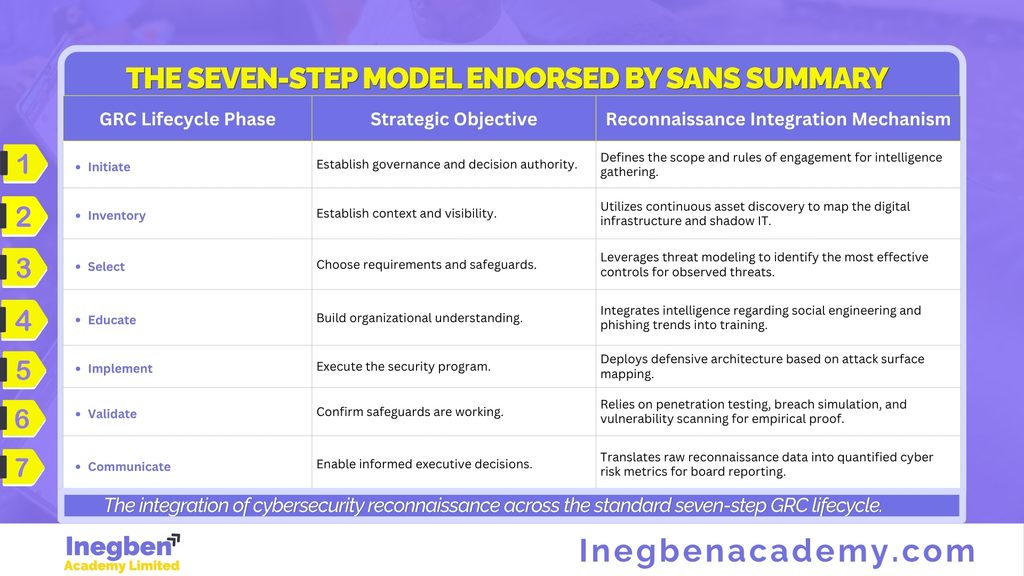
| GRC Lifecycle Phase | Strategic Objective | Reconnaissance Integration Mechanism |
|---|---|---|
| Initiate | Establish governance and decision authority. | Defines the scope and rules of engagement for intelligence gathering. |
| Inventory | Establish context and visibility. | Utilizes continuous asset discovery to map the digital infrastructure and shadow IT. |
| Select | Choose requirements and safeguards. | Leverages threat modeling to identify the most effective controls for observed threats. |
| Educate | Build organizational understanding. | Integrates intelligence regarding social engineering and phishing trends into training. |
| Implement | Execute the security program. | Deploys defensive architecture based on attack surface mapping. |
| Validate | Confirm safeguards are working. | Relies on penetration testing, breach simulation, and vulnerability scanning for empirical proof. |
| Communicate | Enable informed executive decisions. | Translates raw reconnaissance data into quantified cyber risk metrics for board reporting. |
Table 1 shows the integration of cybersecurity reconnaissance across the standard seven-step GRC lifecycle.
Continuous Threat Exposure Management (CTEM) as the Operational Engine
The historical reliance on traditional Vulnerability Management (VM) has proven inadequate for modern GRC requirements. Legacy VM programs rely heavily on periodic scanning, resulting in vast, unprioritized lists of Common Vulnerabilities and Exposures (CVEs) scored by generic Common Vulnerability Scoring System (CVSS) metrics.
Research indicates that only approximately 0.53% of theoretical CVEs are ever exploited in the wild, and over 97% of actually exploitable conditions are not CVEs at all, but rather misconfigurations, exposed identities, and credential leaks.
Furthermore, nearly 89% of exploitable CVEs never appear on traditional outdated component lists, and only 2% of total exposures actually lead to critical business assets.
To rectify this operational failure, Gartner introduced the Continuous Threat Exposure Management (CTEM) framework in 2022, redefining how GRC programs approach vulnerability and risk.
CTEM shifts the operating model from periodic assessment and ticketing to a continuous, proactive cycle. Gartner’s strategic planning assumption predicted that by 2026, organizations prioritizing their security investments based on a CTEM program would be three times less likely to suffer a breach.
This is critical given that the global average cost of a data breach reached $4.44 million in recent years, and 61% of vulnerabilities are weaponized within 48 hours of disclosure.
CTEM solves the systemic failure of legacy VM by integrating offensive reconnaissance into a continuous, five-stage lifecycle that aligns perfectly with GRC risk management objectives.
The Five Stages of CTEM in GRC Reconnaissance
The first stage, Scoping, dictates the boundaries of the exposure management program. Governance leaders and security teams collaborate to define critical assets, regulatory boundaries, and risk tolerance.
Reconnaissance informs scoping by revealing the actual, rather than the documented, network architecture.
Modern scoping must extend beyond traditional servers and endpoints to include cloud accounts, SaaS tenants, CI/CD pipelines, supplier portals, and high-risk partners. Without rigorous scoping guided by continuous intelligence, enterprises risk overspending on defending low-value systems while leaving critical assets exposed.
The second stage, Discovery, maps the exposures across the defined scope. This stage utilizes External Attack Surface Management (EASM) and Cyber Asset Attack Surface Management (CAASM) to map the environment continuously, identifying both known and hidden assets, misconfigurations, and identity risks.
Discovery uncovers the data that feeds compliance monitoring, ensuring that organizations maintain visibility over shadow IT and public-facing endpoints that traditional firewalls and network scanning tools cannot effectively track.
The third stage, Prioritization, correlates technical exploitability with business impact. GRC principles require risks to be prioritized based on context rather than generic severity.
CTEM utilizes machine-learning models, threat intelligence, and attack path analysis to filter the millions of raw findings down to the fraction of a percent that are actually reachable, exploitable, and undefended by existing compensating controls.
This threat-centric approach ensures that limited analyst hours are directed toward exposures that genuinely threaten the business.
The fourth stage, Validation, is the cornerstone of CTEM and the definitive differentiator from traditional scanning. Validation ensures that identified threats are actionable by confirming, through empirical testing, that an exposure is genuinely exploitable.
Through automated penetration testing, red teaming, and Breach and Attack Simulation (BAS), reconnaissance techniques simulate real-world attack chains to confirm whether an attack path is viable and whether existing security controls can mitigate it effectively.
For GRC professionals, validation acts as the definitive proof required for audit compliance, eliminating false positives and delivering remediation-ready evidence.
The final stage, Mobilization, translates validated findings into remediation workflows and actionable governance. This phase bridges IT, security, and GRC by automating ticket creation, enforcing Service Level Agreements (SLAs), and updating compliance dashboards.
Mobilization ensures that security improvements are operationalized, whether through applying patches, updating configurations, or implementing new compensating controls, and progress is tracked continuously.
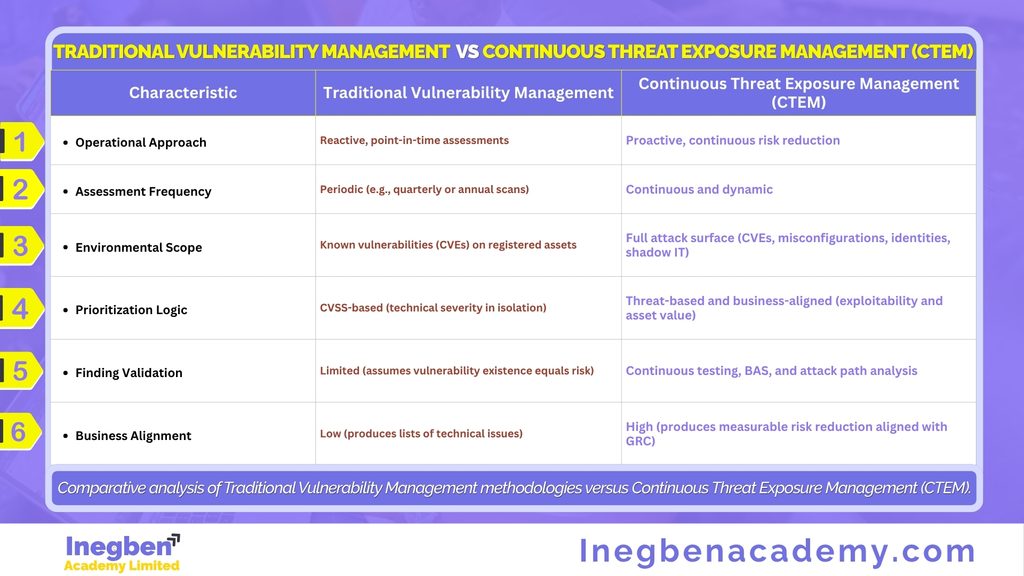
| Characteristic | Traditional Vulnerability Management | Continuous Threat Exposure Management (CTEM) |
|---|---|---|
| Operational Approach | Reactive, point-in-time assessments | Proactive, continuous risk reduction |
| Assessment Frequency | Periodic (e.g., quarterly or annual scans) | Continuous and dynamic |
| Environmental Scope | Known vulnerabilities (CVEs) on registered assets | Full attack surface (CVEs, misconfigurations, identities, shadow IT) |
| Prioritization Logic | CVSS-based (technical severity in isolation) | Threat-based and business-aligned (exploitability and asset value) |
| Finding Validation | Limited (assumes vulnerability existence equals risk) | Continuous testing, BAS, and attack path analysis |
| Business Alignment | Low (produces lists of technical issues) | High (produces measurable risk reduction aligned with GRC) |
Table 2: Comparative analysis of Traditional Vulnerability Management methodologies versus Continuous Threat Exposure Management (CTEM).
Mapping Reconnaissance to Global Regulatory Frameworks
The integration of continuous reconnaissance is not merely a theoretical best practice; it has been codified into the bedrock of international cybersecurity regulations and standards.
Compliance auditors no longer accept static policy documents as evidence of security; they explicitly demand empirical proof of continuous exposure management, threat intelligence integration, and operational control validation.
ISO/IEC 27001:2022: The Demand for Operational Evidence
The 2022 revision of the ISO/IEC 27001 standard fundamentally shifted the auditor’s expectations from policy implementation to operational evidence.
The Information Security Management System (ISMS) certification cycle spans three years, with annual surveillance audits requiring organizations to prove that technical controls operate continuously and effectively throughout the entire period. Reconnaissance directly fulfills the evidence requirements of several critical Annex A controls.
Control A.5.7 (Threat Intelligence) mandates that threat intelligence be collected, analyzed, and systematically actioned. In practice, this means GRC teams must demonstrate that when a new vulnerability is published or a new adversary tactic is identified in the wild, reconnaissance mechanisms immediately operationalize that intelligence to check organizational assets.
A point-in-time annual assessment fails to satisfy this control; auditors require concrete proof that published CVEs become operational checks against the organization’s specific infrastructure.
Control A.8.8 (Management of Technical Vulnerabilities) replaces older, static patch management paradigms by requiring that information regarding technical vulnerabilities be used to evaluate exposure continuously.
Auditors reviewing A.8.8 seek a comprehensive, timestamped evidence chain: proof that the vulnerability existed, proof that it was validated (via reconnaissance or pentesting), proof that it was remediated, and proof that the fix held over time without configuration drift.
Platforms integrating continuous penetration testing produce this exact technical evidence, allowing GRC teams to shape the audit conversation rather than scrambling to gather disjointed intelligence.
Controls A.8.20 (Networks Security) and A.8.21 (Security of Network Services) dictate that networks must be secured against unauthorized interception, spoofing, and man-in-the-middle attacks.
Organizations rely on continuous network reconnaissance and monitoring to detect unauthorized devices, filter traffic, and authenticate connections, thereby generating the logs and anomaly detection records required for compliance.
NIST Frameworks: SP 800-53 and SP 800-137
The National Institute of Standards and Technology (NIST) provides the architectural blueprint for federal, defense, and critical infrastructure GRC through its Risk Management Framework (RMF). The RMF establishes a disciplined, flexible process for managing security risk, and reconnaissance is embedded throughout its controls.
NIST Special Publication 800-53 (Revision 5) establishes the comprehensive control catalog. Controls such as RA-3 (Risk Assessment) and RA-5 (Vulnerability Monitoring and Scanning) mandate that organizations actively scan for vulnerabilities, assess supply chain risks, and maintain deep visibility over their attack surface.
Control SI-4 (System Monitoring) dictates the continuous optimization of network traffic analysis to detect anomalous behavior.
However, the operationalization of these broad controls is strictly governed by NIST SP 800-137: Information Security Continuous Monitoring (ISCM). SP 800-137 explicitly shifts the federal paradigm away from static, three-year authorization cycles to an architecture of ongoing system authorization and near real-time risk management.
ISCM is structured across three organizational tiers to ensure that reconnaissance data supports decision-making at all levels:
- Tier 1 (Governance/Organization Level): Establishes the overarching ISCM strategy, metrics, and risk tolerance, aligning reconnaissance efforts with the organizational mission.
- Tier 2 (Mission/Business Process Level): Information System Owners maintain continuous asset inventories and verify the adequacy of deployed security controls against the organization’s risk profile.
- Tier 3 (Information Systems Level): The tactical execution environment where automated asset discovery, vulnerability scanning, and threat intelligence ingestion occur to ensure controls operate as intended over time.
To implement this architecture, NIST SP 800-137 outlines a six-step process: defining the monitoring strategy, establishing the ISCM program, implementing monitoring capabilities, analyzing and reporting findings, responding to findings, and reviewing/updating the overall strategy.
By utilizing automated reconnaissance tools, such as CAASM and EASM, GRC teams meet the rigorous demands of SP 800-137. Automation replaces manual sampling, allowing risk metrics to be aggregated rapidly, thereby providing executive leadership with the continuous visibility required to make cost-effective, risk-management decisions.
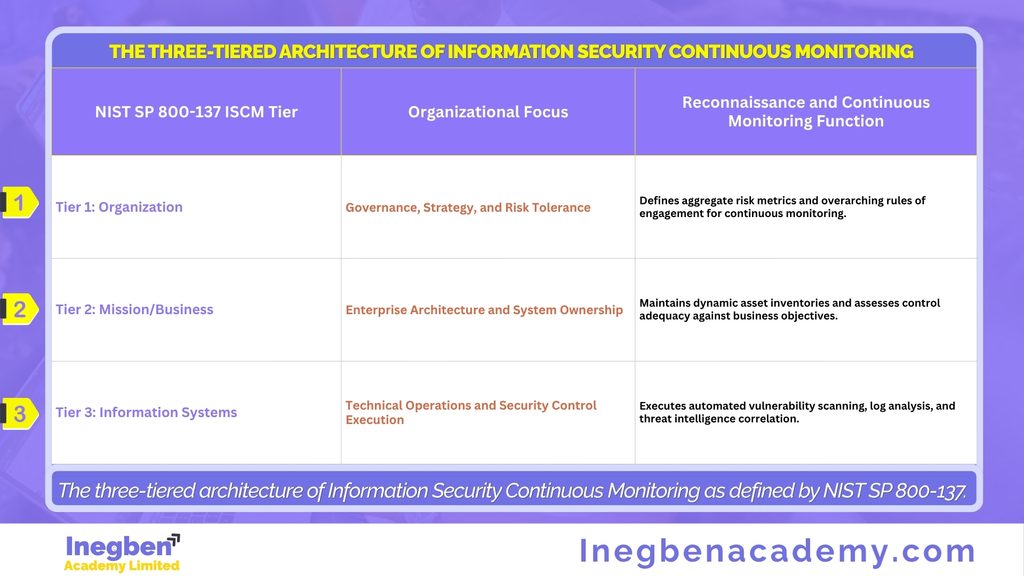
| NIST SP 800-137 ISCM Tier | Organizational Focus | Reconnaissance and Continuous Monitoring Function |
|---|---|---|
| Tier 1: Organization | Governance, Strategy, and Risk Tolerance | Defines aggregate risk metrics and overarching rules of engagement for continuous monitoring. |
| Tier 2: Mission/Business | Enterprise Architecture and System Ownership | Maintains dynamic asset inventories and assesses control adequacy against business objectives. |
| Tier 3: Information Systems | Technical Operations and Security Control Execution | Executes automated vulnerability scanning, log analysis, and threat intelligence correlation. |
Table 3: The three-tiered architecture of Information Security Continuous Monitoring as defined by NIST SP 800-137.
Threat-Led Penetration Testing and Financial Sector Mandates
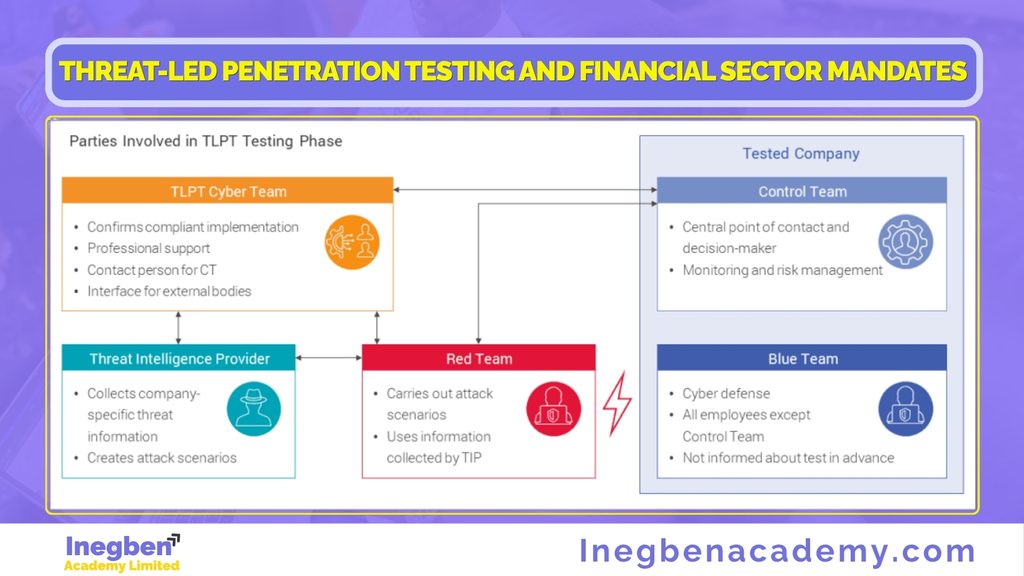
The European Union’s Digital Operational Resilience Act (DORA), which mandates full compliance by January 2025, represents the most aggressive and highly structured regulatory integration of offensive reconnaissance into enterprise GRC.
DORA standardizes digital resilience across EU financial entities, ensuring they can withstand, respond to, and recover from severe ICT-related disruptions.
A central pillar of DORA is the enforcement of advanced digital operational resilience testing, specifically Threat-Led Penetration Testing (TLPT).
TLPT diverges significantly from standard, compliance-driven penetration testing, which typically focuses on identifying unpatched vulnerabilities within a narrowly defined, non-production scope.
In contrast, TLPT simulates sophisticated, real-world attacker tactics against live production systems, providing a highly realistic picture of an institution’s security posture.
DORA’s TLPT requirements are explicitly aligned with the TIBER-EU (Threat Intelligence-Based Ethical Red Teaming) framework developed by the European Central Bank. DORA mandates that significant financial entities, specifically those exceeding EUR 150 billion in total payment transactions over the previous two financial years, must complete a full TLPT cycle at least once every three years.
The Phases of Threat-Led Penetration Testing (TLPT) in GRC Reconnaissance
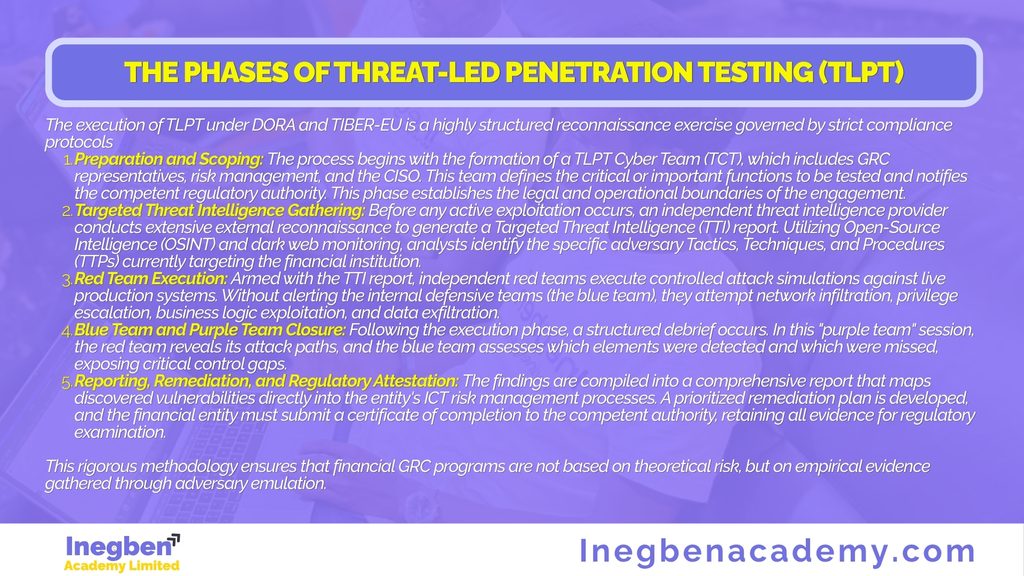
The execution of TLPT under DORA and TIBER-EU is a highly structured reconnaissance exercise governed by strict compliance protocols.
- Preparation and Scoping: The process begins with the formation of a TLPT Cyber Team (TCT), which includes GRC representatives, risk management, and the CISO. This team defines the critical or important functions to be tested and notifies the competent regulatory authority. This phase establishes the legal and operational boundaries of the engagement.
- Targeted Threat Intelligence Gathering: Before any active exploitation occurs, an independent threat intelligence provider conducts extensive external reconnaissance to generate a Targeted Threat Intelligence (TTI) report. Utilizing Open-Source Intelligence (OSINT) and dark web monitoring, analysts identify the specific adversary Tactics, Techniques, and Procedures (TTPs) currently targeting the financial institution.
- Red Team Execution: Armed with the TTI report, independent red teams execute controlled attack simulations against live production systems. Without alerting the internal defensive teams (the blue team), they attempt network infiltration, privilege escalation, business logic exploitation, and data exfiltration.
- Blue Team and Purple Team Closure: Following the execution phase, a structured debrief occurs. In this “purple team” session, the red team reveals its attack paths, and the blue team assesses which elements were detected and which were missed, exposing critical control gaps.
- Reporting, Remediation, and Regulatory Attestation: The findings are compiled into a comprehensive report that maps discovered vulnerabilities directly into the entity’s ICT risk management processes. A prioritized remediation plan is developed, and the financial entity must submit a certificate of completion to the competent authority, retaining all evidence for regulatory examination.
This rigorous methodology ensures that financial GRC programs are not based on theoretical risk, but on empirical evidence gathered through adversary emulation.
Federal Agility and Sovereign Data Privacy
The demand for continuous reconnaissance extends beyond the financial sector, deeply influencing sovereign data privacy laws and federal government operations.
CISA Binding Operational Directive 26-04 in GRC Reconnaissance
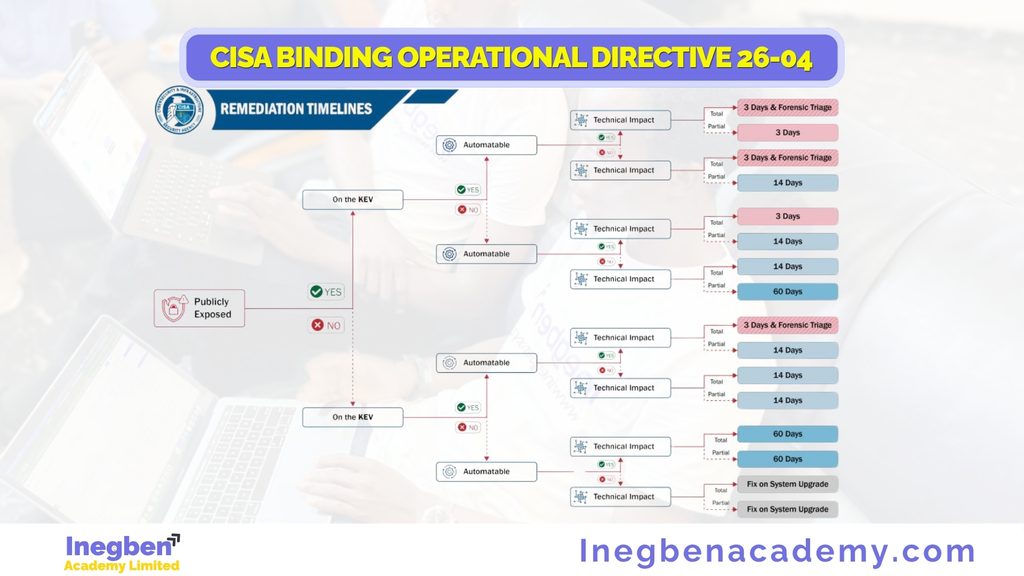
In the United States, the Cybersecurity and Infrastructure Security Agency (CISA) revolutionized federal vulnerability management in June 2026 with the issuance of Binding Operational Directive (BOD) 26-04: Prioritizing Security Updates Based on Risk.
BOD 26-04 rescinded the flat 14-day patching rule for Known Exploited Vulnerabilities (KEVs), recognizing that AI-accelerated threat actors compress the gap between vulnerability disclosure and weaponized exploitation to a matter of hours.
In place of flat deadlines, BOD 26-04 introduced a dynamic, risk-based matrix utilizing four variables to determine remediation timelines.
The most critical variable is Asset Exposure: determining whether the vulnerable asset is publicly exposed and reachable from outside the network on a routable IP address.
For critical KEVs that grant total system control on internet-exposed assets, the directive compresses the remediation timeline to just three days, accompanied by mandatory forensic triage.
The forensic triage sequence is strictly timed: 0-2 hours for scoping, 2-24 hours to preserve and contain, 24-48 hours for triage analysis, and 48-72 hours for an escalation decision.
This directive explicitly mandates continuous external reconnaissance.
Federal agencies and compliant contractors cannot rely solely on registered asset lists scanned by CISA’s internal tools; they must proactively deploy External Attack Surface Management (EASM) to discover unregistered, forgotten, or shadow IT assets.
If GRC teams fail to conduct adequate reconnaissance, their exposure assessments will be inaccurate, leading to missed 3-day statutory triage deadlines and direct non-compliance with federal law.
Nigeria Data Protection Act (NDPA) 2023
In emerging digital economies, data protection acts increasingly mandate structural cybersecurity measures. The Nigeria Data Protection Act (NDPA) 2023, augmented by the General Application and Implementation Directive (GAID) 2025, provides a comprehensive legal framework to safeguard personal data and align Nigeria with global best practices.
Under the NDPA, entities that process the personal data of over 200 data subjects within any six-month period, or process high-risk data across critical sectors (e.g., financial services, aviation, healthcare), qualify as Data Controllers or Processors of Major Importance (DCPMIs).
DCPMIs are subject to rigorous GRC requirements, including the mandatory appointment of a qualified Data Protection Officer (DPO), the execution of Data Protection Impact Assessments (DPIAs) prior to high-risk processing, and the annual filing of Data Protection Compliance Audit Returns (CAR) prepared by licensed Data Protection Compliance Organisations (DPCOs).
The NDPA explicitly requires organizations to implement “appropriate technical and organizational measures” to ensure a level of security commensurate with the risk, including encryption, access controls, and the regular testing of security measures. In this context, continuous reconnaissance acts as the validation mechanism.
To satisfy the Nigeria Data Protection Commission (NDPC) audits and avoid severe administrative fines, which can reach up to ₦10 million or 2% of annual gross revenue, organizations must utilize vulnerability management and continuous monitoring to empirically prove that their perimeter defenses effectively mitigate the risk of a breach.
Technological Integration: Automating Threat Intelligence Exchange
Translating raw reconnaissance data into actionable GRC metrics requires a highly structured technological ecosystem. The massive volume of data generated by global threat intelligence providers, network scanners, and EASM platforms cannot be processed manually.
To bridge the gap between tactical reconnaissance and strategic GRC, the cybersecurity industry relies on OASIS open standards: Structured Threat Information Expression (STIX) and Trusted Automated eXchange of Intelligence Information (TAXII).
STIX 2.1 provides a standardized, JSON-based lexicon for representing cyber threat intelligence in a machine-readable format. It structures complex data into specific STIX Domain Objects (SDOs) such as Threat Actor, Campaign, Indicator, Malware, Vulnerability, and Infrastructure.
Crucially, STIX Relationship Objects link these entities together (e.g., specifying that an Indicator detects specific Malware, which was used by a specific Threat Actor in a particular Campaign).
This creates a comprehensive, relational knowledge graph of the threat landscape. Furthermore, STIX 2.1 utilizes pattern-based detection rules (e.g., combining file hashes, registry keys, and network observables) to describe malicious behavior precisely.
TAXII 2.1 acts as the companion transport protocol, defining how STIX data is securely exchanged over HTTPS via RESTful APIs. It allows threat intelligence platforms to organize data into Collections, enabling automated polling and pushing of intelligence between organizations and tools.
GRC and Operational Integration: For GRC architects and SOC operations, the STIX/TAXII integration is a critical force multiplier.
When a threat intelligence feed identifies a novel adversary campaign, the STIX 2.1 Indicator pattern is transported via TAXII directly to the organization’s Security Information and Event Management (SIEM) system (e.g., Splunk, Elastic) or Endpoint Detection and Response (EDR) platform.
Tools like STIX Shifter automatically convert the STIX patterns into native SIEM queries, searching internal logs for signs of exposure.
If an exposure is detected, Security Orchestration, Automation, and Response (SOAR) platforms trigger workflows that automatically update the GRC platform’s centralized risk register, linking the technical Indicator of Compromise (IOC) directly to the affected business asset and its associated compliance risk.
This seamless automation ensures that intelligence data is consistent, reduces format translation overhead, and creates an automated, defensible audit trail of threat identification and response required by continuous monitoring mandates.
Key STIX 2.1 Domain Objects and their operational applications within a GRC framework.
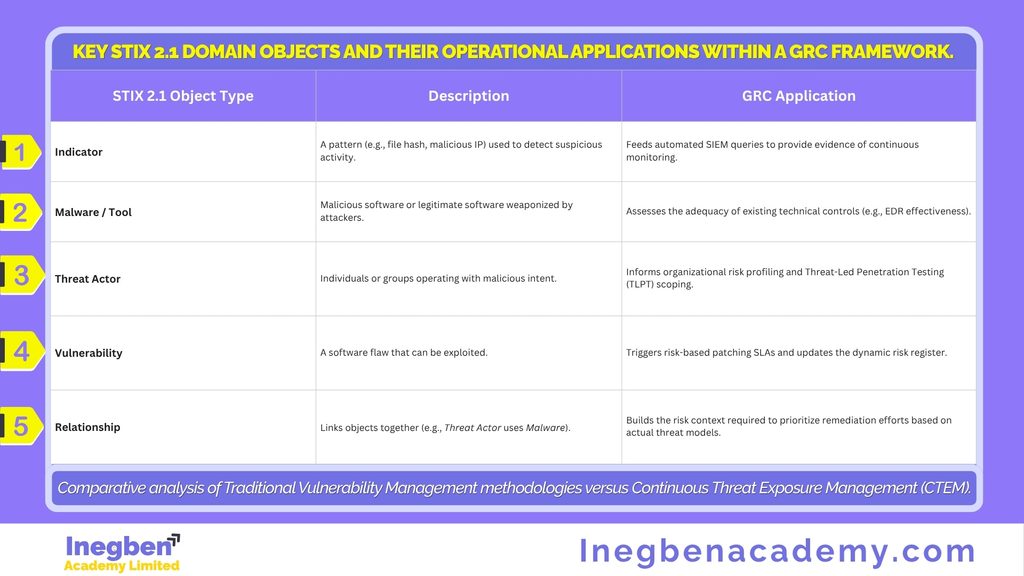
| STIX 2.1 Object Type | Description | GRC Application |
|---|---|---|
| Indicator | A pattern (e.g., file hash, malicious IP) used to detect suspicious activity. | Feeds automated SIEM queries to provide evidence of continuous monitoring. |
| Malware / Tool | Malicious software or legitimate software weaponized by attackers. | Assesses the adequacy of existing technical controls (e.g., EDR effectiveness). |
| Threat Actor | Individuals or groups operating with malicious intent. | Informs organizational risk profiling and Threat-Led Penetration Testing (TLPT) scoping. |
| Vulnerability | A software flaw that can be exploited. | Triggers risk-based patching SLAs and updates the dynamic risk register. |
| Relationship | Links objects together (e.g., Threat Actor uses Malware). | Builds the risk context required to prioritize remediation efforts based on actual threat models. |
Table 4: Key STIX 2.1 Domain Objects and their operational applications within a GRC framework.
Third-Party Risk Management (TPRM) and Cyber Risk Quantification in GRC
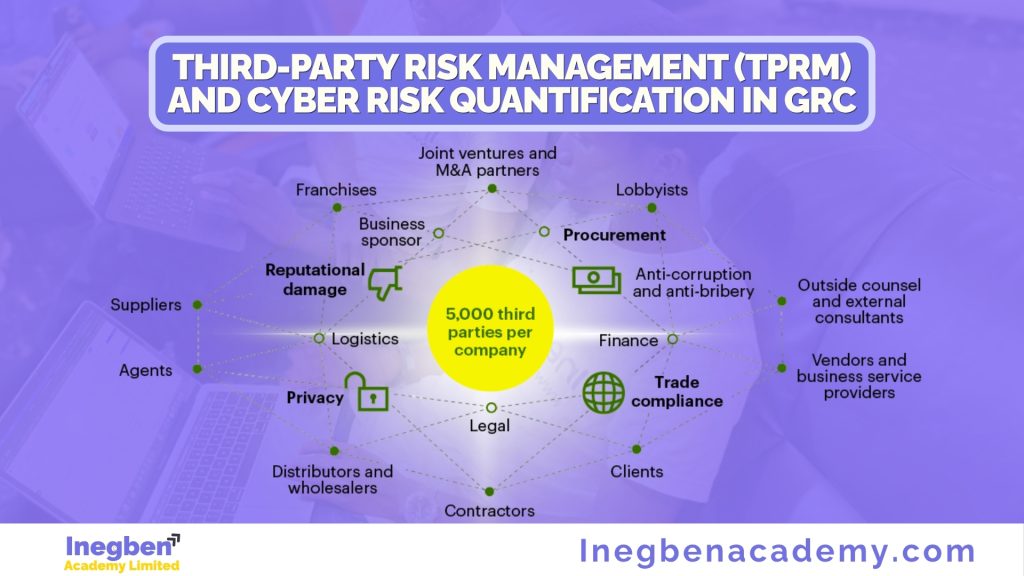
The digital perimeter of an organization no longer ends at its own firewall. Massive migrations to hybrid cloud architectures, the adoption of SaaS platforms, and deeply interconnected digital supply chains have outsourced significant operational capabilities to third parties.
Under regulatory frameworks like GDPR, HIPAA, and DORA, regulatory accountability does not transfer to the vendor; the primary organization remains legally liable for data breaches and service disruptions. High-profile supply chain compromises, such as the SolarWinds and MOVEit breaches, have starkly demonstrated that third-party vulnerabilities pose an existential threat to enterprise operations.
Third-Party Risk Management (TPRM) extends GRC principles into the supply chain, moving beyond static, annual security questionnaires to rely on continuous external reconnaissance.
- Contractual Governance: GRC dictates that vendor contracts must include robust security language to mitigate risk legally. This includes explicit Right to Audit clauses, stringent breach notification SLAs, data return and secure deletion provisions, and indemnification clauses that hold the vendor financially responsible for security failures and regulatory fines arising from their negligence.
- Continuous Vendor Reconnaissance: Because manual vendor risk assessments represent a point-in-time snapshot, GRC teams increasingly deploy EASM tools to actively and continuously monitor the external security posture of their critical vendors. If reconnaissance reveals that a critical software provider has an exposed, unpatched server harboring a known CVE, the primary organization’s GRC platform can automatically flag the vendor, triggering a contractual remediation demand before a lateral supply chain breach occurs.
Translating Reconnaissance to the Board: Cyber Risk Quantification (CRQ)
A fundamental challenge in GRC is bridging the communication gap between technical cybersecurity teams and the Board of Directors.
Presenting a report indicating that an organization possesses “50 High-Severity CVEs” lacks the business context required for executive decision-making. Cyber Risk Quantification (CRQ) solves this by translating raw reconnaissance data into actionable monetary values.
The preeminent framework for CRQ is the Factor Analysis of Information Risk (FAIR) model. FAIR replaces subjective, qualitative risk matrices (which label risks ambiguously as High, Medium, or Low) with probabilistic financial models that executives can understand.
FAIR defines Risk as a mathematical function of two primary components: Loss Event Frequency (the probability that a threat agent will act against an asset and successfully exploit a vulnerability) and Loss Magnitude (the probable financial cost of the breach, including incident response costs, regulatory fines, operational downtime, and reputational damage).
The synthesis of continuous reconnaissance, CTEM, and CRQ creates a highly defensible GRC strategy:
- Attack Surface Management (ASM) provides the initial visibility, identifying existing vulnerabilities (e.g., 50 exposed servers running deprecated software).
- Continuous Threat Exposure Management (CTEM) utilizes threat intelligence to validate the Likelihood of those specific servers being exploited by active threat actors.
- Cyber Risk Quantification (CRQ) takes this validated exposure data, combines it with asset valuation, and calculates the Annualized Loss Expectancy (ALE).
For example, if reconnaissance proves a 70% annual likelihood of an exploit against a critical database, and GRC analysis determines a $500,000 impact per incident, the Expected Annual Loss (EAL) is $350,000.
This financial modeling allows the Chief Information Security Officer (CISO) to mathematically justify a $100,000 investment in a compensating control, demonstrating a clear Return on Investment (ROI) to the Board and enabling risk-based decisions to accept, mitigate, or transfer the risk via cyber liability insurance.
Legal Liability and the Boundaries of Active Reconnaissance
While continuous reconnaissance is vital for monitoring and compliance, it carries significant legal risks. GRC professionals must strictly govern the rules of engagement, as the boundary between authorized vulnerability validation and illegal computer intrusion is defined by stringent legal statutes.
The Computer Fraud and Abuse Act (CFAA) – United States
In the United States, the Computer Fraud and Abuse Act (CFAA) is the primary federal criminal statute addressing cybersecurity. The CFAA criminalizes “unauthorized access” or access that “exceeds authorization” to a protected computer.
GRC teams directing active reconnaissance (such as aggressive port scanning, vulnerability exploitation, or automated penetration testing) must ensure they have explicit, documented authorization for every IP address, domain, and asset within the scope of the test.
If an automated ASM tool inadvertently scans a third-party host situated on shared infrastructure without explicit permission, the organization may face severe civil or criminal liability under the CFAA, as intent to secure one’s own network does not provide safe harbor for unauthorized scanning of another’s.
The Cybercrimes (Prohibition, Prevention, etc.) Act 2015 – Nigeria
Similarly, international jurisdictions enforce strict anti-hacking laws. In Nigeria, the Cybercrimes (Prohibition, Prevention, etc.) Act of 2015 strictly prohibits hacking, unauthorized access, identity theft, and network interference.
Cloud providers and ISPs operating in the region enforce these laws strictly via Acceptable Use Policies (AUPs). Conducting unapproved port scanning, network probing, or vulnerability testing against third-party networks—even if intended solely for threat intelligence gathering—constitutes a criminal offense.
Consequently, a mature GRC program requires rigorous legal oversight of all CTEM and reconnaissance activities. Scoping documents must clearly delineate owned assets versus third-party assets, and external penetration testing mandates comprehensive authorization documentation (often referred to as a “Get Out of Jail Free” card) to shield the organization, its contractors, and its security practitioners from liability.
The Future Landscape: Agentic AI in GRC Automation

As the velocity of cyber threats and the scale of digital infrastructures outpace human analytical capacity, the future of GRC and reconnaissance relies heavily on Artificial Intelligence (AI). The integration of Large Language Models (LLMs) and intelligent, autonomous agents into GRC platforms represents a massive leap in operational resilience and threat detection capability.
Modern AI agents in cybersecurity are moving beyond simple natural language processing and static alert generation into autonomous, multi-step reasoning. In a sophisticated CTEM ecosystem, an AI agent can ingest raw STIX 2.1 threat intelligence regarding a novel zero-day vulnerability as soon as it is published.
Operating autonomously, the agent can:
- Query the CAASM platform to map the internal blast radius and identify all assets susceptible to the vulnerability.
- Initiate safe, simulated exploitation scripts (validation) against a digital twin of the environment to confirm reachability and exploitability.
- Cross-reference the validated findings against the GRC database to identify which regulatory frameworks (e.g., ISO 27001, DORA, PCI-DSS) are impacted by the exposure.
- Generate a highly contextualized draft remediation plan, calculate the cyber risk quantification impact, and route it to the appropriate IT operations team for rapid execution.
This level of AI-driven predictive modeling transforms GRC from a reactive reporting function into a proactive, real-time defense mechanism. However, academic studies analyzing AI deployment in financial markets demonstrate that the success of AI-driven GRC is not solely dependent on the sophistication of the algorithm.
It is highly dependent on the quality of the underlying governance infrastructure—including data quality, metadata lineage, model oversight, and ethical AI frameworks. Organizations that attempt to deploy autonomous AI agents without strong foundational GRC hygiene will face compounded risks of hallucination, automated misconfiguration, and severe compliance violations.
Conclusion
The convergence of cybersecurity reconnaissance and Governance, Risk, and Compliance represents one of the most consequential strategic developments in modern enterprise security. The era of static, checklist-based compliance has unequivocally ended, replaced by the necessity for continuous, intelligence-driven validation.
Frameworks such as Continuous Threat Exposure Management (CTEM) provide the operational blueprint, ensuring that organizations discover, prioritize, and validate threats based on real-world exploitability rather than theoretical scores. Global regulations and standards codify this shift into binding mandates: from ISO/IEC 27001:2022’s demand for continuous operational evidence, to DORA’s stringent requirements for Threat-Led Penetration Testing in the financial sector, to CISA BOD 26-04’s aggressive exposure-based remediation SLAs.
To execute this mandate successfully, GRC architectures must leverage sophisticated technological ecosystems. Cyber Asset Attack Surface Management provides necessary visibility, STIX and TAXII protocols automate threat intelligence sharing, and Cyber Risk Quantification frameworks like FAIR translate technical realities into the financial metrics required for executive governance.
As Artificial Intelligence further accelerates these capabilities, organizations that successfully weave continuous reconnaissance into the fabric of their GRC programs will achieve unparalleled operational resilience, transforming compliance from an administrative burden into a dynamic, strategic advantage.

 Inegben Academy